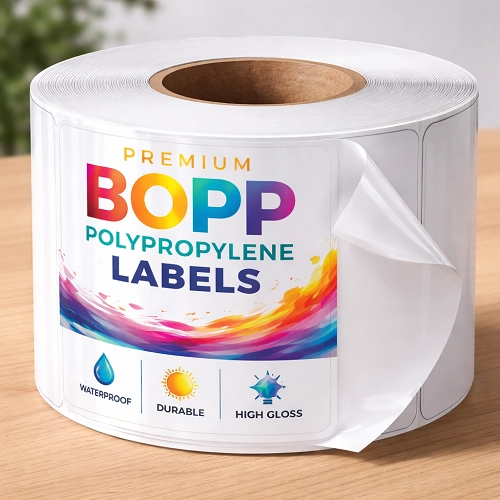
BOPP (Biaxially Oriented Polypropylene) roll labels are among the most widely deployed labeling materials in packaging and product identification across industries. Their unique combination of durability, print quality, chemical resistance, and cost-effectiveness makes them a go-to solution for everything from consumer goods to industrial products.
1. What Are BOPP Polypropylene Roll Labels?
BOPP stands for Biaxially Oriented Polypropylene, a film made from polypropylene that has been stretched in both the machine and transverse directions. This biaxial orientation enhances the mechanical properties of polypropylene, resulting in a film with:
- High tensile strength and tear resistance
- Excellent dimensional stability
- Increased clarity and gloss (for transparent grades)
- Enhanced stiffness compared to non-oriented polypropylene
When supplied as roll labels, BOPP films are typically pre-coated with adhesives and wound on rolls for use in automatic, semi-automatic, or manual labeling systems.
2. Material Structure and Properties
The performance of BOPP labels comes from the interaction of three layers:
a) Face Stock (Film Layer)
The base material, BOPP film, can be:
- Clear/transparent: Ideal for “no-label” look or when product visibility is desirable.
- White opaque: Provides excellent opacity and a bright print surface.
- Metallized: Adds a premium metallic finish for branding.
Key properties:
- Low moisture absorption
- Chemical and oil resistance
- Good stiffness and lay-flat performance
- Temperature resistance suitable for chilled/frozen goods
b) Adhesive Layer
The adhesive determines how the label bonds to the surface. Common adhesive types include:
- General permanent acrylic: Balanced adhesion for most smooth surfaces.
- High-tack acrylic: Strong initial bond for textured or low-energy plastics.
- Cold-temperature acrylic: Maintains adhesion at sub-ambient conditions.
- Removable adhesives: For repositionable or temporary labeling.
c) Release Liner
Typically a silicone-coated paper or film that protects the adhesive until application. Liners influence:
- Die-cut precision
- Web handling on press
- Waste and recycling considerations
3. Printing Technologies for BOPP Labels
Selecting the right printing technology impacts image quality, durability, and cost.
a) Flexographic Printing
- Most common method for roll labels.
- Fast press speeds and low unit cost.
- Suitable for simple to moderately detailed graphics.
- UV, solvent, water-based, and EB/UV inks can be used (depending on press).
Challenges & considerations:
- Dot gain must be controlled through proper plate exposure and anilox selection.
- Requires accurate tension control due to film elasticity.
b) Digital Printing
- Ideal for short runs and versioning.
- Excellent print quality and fast turnaround.
- Common platforms include Indigo, Xeikon, and toner-based presses.
Material considerations:
- Primer coatings may be needed for ink adhesion.
- Film must be compatible with press fusing/curing temperatures.
c) Thermal Transfer Printing (TTP)
- Used for on-demand applications like barcodes and logistics labels.
- Requires thermal transfer ribbons formulated for polypropylene (resin ribbons).
Key benefits:
- Durable, scratch-resistant print
- Good for high-contrast and barcoded labels
4. Adhesion and Surface Energy
A crucial technical parameter is surface energy of the substrate (product container). BOPP films typically have surface energies above 38 dynes/cm, but many plastics (e.g., HDPE, LDPE, PP containers) are low-energy surfaces (<38 dynes/cm). To achieve reliable adhesion:
- Choose high-tack or specialty adhesives
- Consider surface treatments on substrates (flame, corona, plasma)
- Control application pressures and dwell time
A common test is the dyne pen test to measure surface energy and guide adhesive selection.
5. Environmental and Durability Considerations
a) Temperature Extremes
BOPP labels generally withstand:
- Cold temperatures: Suitable for refrigeration/freezer conditions when paired with cold-temperature adhesives.
- Moderate heat: Up to 80–90 °C for short durations depending on adhesive.
High heat exposure can cause adhesive migration or film distortion.
b) Moisture and Chemicals
BOPP’s hydrophobic nature gives it excellent moisture resistance—ideal for beverages, cosmetics, and outdoor applications. However:
- Solvent exposure and harsh chemicals require solvent-resistant adhesives and ink systems.
- Outdoor durability often involves UV-stable inks and protective overlaminates.
c) Abrasion and Handling
- Matt or textured finishes can better hide surface scratches.
- Clear BOPP shows abrasion more visibly unless overlaminated.
6. Converting and Die-Cutting Challenges
Converting flexible films presents unique challenges:
a) Film Stretch and Web Control
Biaxial orientation improves dimensional stability but film can still:
- Stretch under tension
- Shrink under heat (during drying/curing)
Solution: Maintain consistent web tension and use dancer rollers to absorb fluctuations.
b) Die Cutting
Precise die cutting depends on:
- Sharp tooling
- Correct anvil or magnetic cylinders
- Proper registration
- Distinct liner release characteristics
An improperly set knife can lead to:
- Burst labels (where cuts go too deep)
- Inconsistent registration
- Waste buildup
7. Finishing: Coatings, Lamination & Varnishes
Post-print enhancements can improve performance and aesthetics:
- Gloss/Satin varnish: Improves scuff resistance and visual appeal.
- Protective films/overlaminates: Enhance chemical and abrasion resistance.
- Matte coatings: Reduce glare and produce a premium tactile feel.
Each addition affects:
- Printability
- Cost
- Roll stiffness and wind
- Recyclability
8. Label Application Methods
a) Automatic Labeling
Used in high-speed production environments (up to 500+ ppm). Key factors:
- Label roll diameter and core size
- Adhesive tack and application pressure
- Sensor type for registration (reflective/through-hole)
b) Semiautomatic and Manual
Ideal for shorter runs or specialty products. Label dispenser rewind features can improve operator ergonomics and productivity.
9. Compliance & Recycling Considerations
With sustainability growing in importance:
- Mono-material designs (film + adhesive compatible with recycling streams) are preferred.
- Sorting systems may reject composite materials; choose designs that align with local recycling standards.
- Regulatory compliance (e.g., FDA for food contact) affects adhesive and ink selection.
10. Troubleshooting Common Issues
| Issue |
Possible Cause |
Fix |
| Label lifting |
Low substrate surface energy |
Use high-tack adhesive |
| Ink smearing |
Improper cure/dry |
Adjust UV dose or dryer settings |
| Wrinkled labels |
Excess web tension |
Reduce tension, adjust rollers |
| Poor barcode read rate |
Inadequate print contrast |
Reevaluate print settings/ribbon |
BOPP polypropylene roll labels provide a balance of durability, print quality, and versatility that makes them foundational in modern labeling applications. By understanding the material science behind BOPP, mastering printing and converting techniques, and optimizing for application and environmental conditions, businesses can achieve reliable, high-performance results tailored to their needs.